Building the One Upgrade mobile add-on
Delivering and increasing One Upgrade adoption through research, UX and experimentation
Role
Project lead designer
Industry
eCommerce
Duration
3 months

Project overview
One Upgrade is a unique mobile add-on that allows customers to upgrade their phone whenever they want. I supported the proposition from early concept & research through to launch, product-page design, post-launch optimisation and digital purchase journey visibility.
Problem: A unique mobile upgrade add-on was performing strongly in store, but had limited visibility and explanation in the online device purchase journey.
Opportunity: Surface the proposition during the moment customers were choosing a device, to improve awareness, consideration and uptake.
My role: Led early research and concept testing, designed the product page, collaborated with Product, Marketing, Creative, our agents and later partnered with Data & AI to A/B test PDP banner placement.
Impact: Implemented the product succinctly in the eShop flow. A/B testing showed measurable uplift in uptake, including +50% on iPhone 16 Pro Max and +34.4% on Samsung S25 Ultra - demonstrating my impact on commercial performance.
Why this mattered
One Upgrade remains the only product of its type in the New Zealand mobile market: an add-on to an interest-free phone purchase that allowed customers to upgrade whenever they want. The proposition had strong potential to differentiate One NZ, support interest-free payment sales (a core business focus) and give customers more flexibility in how they own and upgrade devices.
However, the product also required explanation. Its value was often clearest when agents could talk customers through it in store. The challenge was to create a digital experience that could do some of that explanatory work online: making the product easy to understand, commercially compelling and credible enough for customers to consider.

My role
I was involved from early concept ideation of the product and again in the research through to launch and post-launch optimisation of this initiative. I helped the business understand customer appetite and comprehension, then translated a complex proposition into a clear product page and supporting digital experience.
I worked closely with the Product Owner to understand product rules and technical detail, collaborated with Creative and Marketing on imagery and copy, and gathered feedback from in-store agents before and after launch. Post-launch, I used customer feedback, GA and Hotjar analytics to refine the page and later advocated for surfacing One Upgrade directly in the device purchase journey in the form of a marketing banner.
Approach
Validating the proposition before approval
Before the business case was approved, I helped explore whether customers understood the concept and whether the proposition had enough perceived value. This early research pack helped move the conversation beyond internal assumptions and gave the business clearer evidence around customer understanding, appeal (high) and potential barriers.
Translating product complexity into a clear landing page
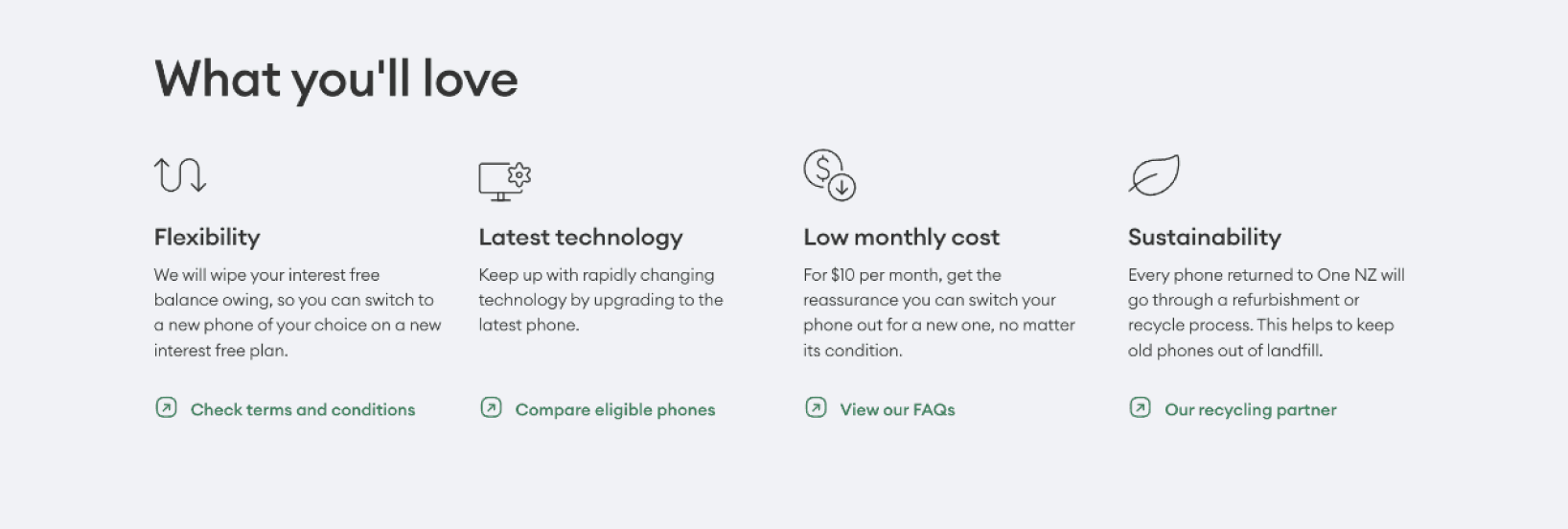
One Upgrade involved product rules, eligibility, fees, upgrade conditions and customer expectations that needed to be communicated simply. I worked closely with the Product Owner to understand the technical detail, then translated that into a landing page structure that explained what the product was, how it worked, what customers loved, and what they needed to know before signing up.
Using agent and customer feedback to improve comprehension
Because One Upgrade launched in-store first, agents were a critical feedback loop. I collaborated with retail teams to understand what customers frequently asked, where explanations broke down and which parts of the proposition needed clearer support. I also tested the page with customers to gauge comprehension and identify where hierarchy, wording or FAQs needed to change.
Optimising after launch with analytics and experimentation
After launch, I used GA and Hotjar data to review how customers were engaging with the page. This led to changes in page hierarchy and FAQ ordering. When the product later moved into digital channels, I directed another review to make sure the page supported the online journey appropriately. Based on strong in-store attachment and limited online visibility, I advocated for PDP marketing banner placement and partnered with Data & AI to A/B test the impact of surfacing One Upgrade within the journey.


Key design decisions
Lead with customer value, then explain the mechanics
Rather than leading with product rules, the page introduced One Upgrade through the customer value proposition: flexibility, control and the ability to upgrade when ready.
Break the proposition into clear steps
I translated product mechanics into a simple “how it works” structure, helping customers understand eligibility, upgrade conditions, fees and what happens when they move to a new phone.
Make fees and conditions visible
Because trust was important for a new proposition, the page needed to make key conditions easy to find. FAQs and fee tables were structured to support customers who wanted more detail before committing.
Use agents as a live feedback loop
In-store agents were hearing customer questions first-hand, so their feedback helped ensure the page answered real customer objections and comprehension gaps.
Move the proposition into the purchase moment
The landing page explained the product, but the larger opportunity was to surface One Upgrade during device shopping. PDP banner testing allowed us to test and prove that visibility at the right moment could influence uptake.


Impact
Product page launched in late 2023 and supported strong initial sales.
Some stores reported One Upgrade attachment upwards of 80% on new interest-free phone purchases, averaging around 40% in-stores and 30% online
Page hierarchy and FAQs were iterated in 2024 using GA, Hotjar, customer feedback and agent insight, further optimising the page
PDP banner testing helped evidence the value of surfacing One Upgrade within the device purchase journey and the value of using A/B testing
The work supported a differentiated mobile proposition with potential to increase a key business metric: interest-free phone sales, and improve customer perception of One NZ’s product offering.
Learnings
Analytics and behavioural data are essential for refining page hierarchy after launch.
Product pages matter, but proposition adoption often depends on surfacing the product at the right point in the customer journey.
Agent feedback can reveal customer objections and comprehension gaps faster than internal review alone.
Defining success metrics early matters. Attachment rate, product understanding, satisfaction, IFP sales impact and brand perception all help demonstrate whether a proposition is creating value.
I learned to trust my instincts and fight for the best CX despite competing business priorities.
Product design · eCommerce UX · Customer research · A/B testing · Behaviour design
Other projects

Integrating One Wallet into the eShop
Using AI-enabled prototyping to validate a loyalty proposition in the purchase journey

Designing a new billing experience
Redesigning a complex bill to reduce customer confusion

Prepay Product Refresh
Launching a new Prepay Plus product across app & web with a new design system

Redesigning a B2B website for Enterprise and Government
A redesign of One NZ’s business website structure to better serve E&G