Integrating One Wallet into the eShop
Using AI-enabled prototyping to validate a loyalty proposition in the purchase journey
Role
Design Manager
Industry
eCommerce
Duration
3-6 months

Project overview
Rapid AI-enabled prototyping to explore how Phone Dollars could be introduced into One NZ’s device PDP, helping validate and implement the first use of a wallet-based proposition in the eShop buy journey.
Problem: A loyalty proposition, One Wallet, needed to be introduced into an already saturated device purchase journey involving the intersection of mobile plans, payment options, eligibility, trade-in, add-ons and fulfilment choice.
Challenge: Explore interaction options quickly, align stakeholders early and gather feedback from internal teams and agents before deeper delivery investment.
My role: Created AI-assisted prototypes, tested concepts with stakeholders and agents, and used feedback to shape the journey direction, content hierarchy and interaction model.
Outcome: Accelerated alignment on a key product milestone and demonstrated how AI-enabled design workflows can improve speed, quality and confidence in early-stage product design. Designs handed over for build within 3 months of project initiation.
Why this mattered
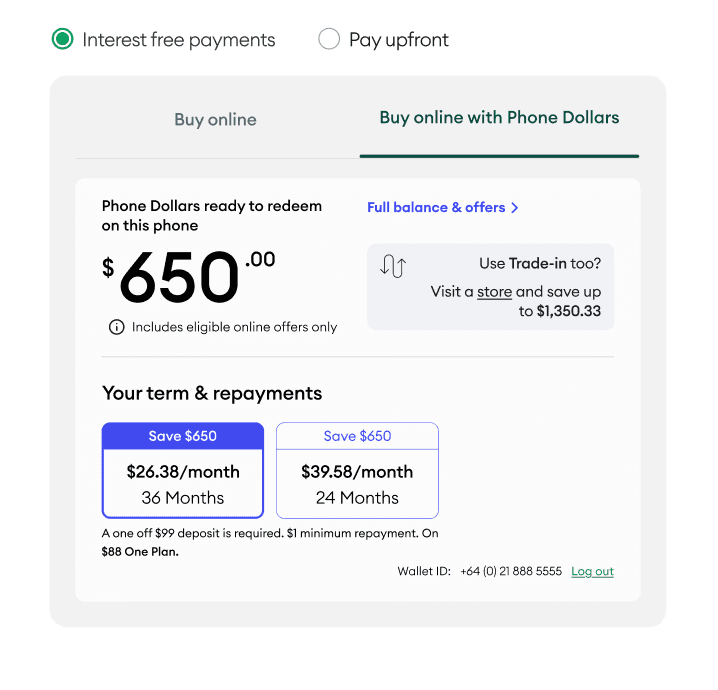
Phone Dollars / One Wallet is a strategically important proposition for One NZ, but bringing it into the device purchase journey created a new design challenge. Until this point, the proposition was advertised online, but there it remained an in-store only redemption option. Introducing it into the eShop flow meant customers needed to understand how their balance could contribute to a new phone purchase without becoming confused by eligibility, interest-free terms or other available products.
The purchase journey was already complex. Customers could be comparing devices, selecting plans, considering interest-free payment terms, using Trade-in, learning about One Upgrade or Satellite add-ons, choosing a store or delivery, and dealing with preorder scenarios. The challenge was to introduce Phone Dollars in a way that made value visible and actionable without overwhelming the customer or creating operational confusion for agents.

My role
I used AI-assisted prototyping to rapidly explore how Phone Dollars could appear within the buy journey. My role was to turn a complex set of product rules, eligibility conditions and operational constraints into tangible journey options that could be reviewed by internal stakeholders and agents early.
The prototypes created mapped where Phone Dollars could appear in the journey, considered how it would interact with existing components, then used stakeholder and agent feedback to refine the journey direction, content hierarchy and decision points.
Approach
Framing the real UX problem
The goal was not simply to show a Phone Dollar balance. The experience needed to show the user the potential value of applying Phone Dollars to an interest-free phone purchase, while making it clear when offers were eligible, available or restricted.
Internal discussion helped identify important problem areas: available offers could be invisible if they were not already in the customer’s wallet, a balance could differ from the amount actually applicable to the selected device, and plan choices could make some Phone Dollar offers ineligible for the current purchase or lessen the discount.
Using AI to move from ambiguity to tangible concepts
Because the journey was early-stage and had many dependencies, AI-assisted prototyping helped turn complex requirements into interactive concepts quickly. This made it easier to compare options, identify gaps and have more productive conversations with stakeholders.
The value of AI was speed and breadth, but the important design decisions still required judgement, for example where the proposition should appear, how much information to reveal, what language would reduce confusion, and how to keep the purchase journey moving.
I created an AI agent to ingest requirements and act as part Product Owner, BA, brand tone of voice guide for copy, and a design assistant for iterative review. I also used platforms such as Google AI Studio and Claude to create the interactive prototypes. This is now something I embed in my workflow.
Designing around product and operational rules
Phone Dollars could not be treated as a simple discount. The journey needed to account for eligibility rules and how redemption amounts could change depending on trade-in valuations and selections made. This meant the design needed to help customers understand value without overpromising certainty too early. It also needed to support agents, who would have to explain edge cases clearly if the journey moved into store completion or telesales/customer service.
Validating with stakeholders and agents
I used the prototypes to gather feedback from internal teams and agents before deeper delivery investment. This helped surface issues around copy, customer comprehension, store handoff, product combinations and operational feasibility.
The review process also showed how Phone Dollars needed to coexist with other device-purchase products, including Trade-in and One Upgrade. Utilising agents in-store also helped raise common questions around product comprehension and proved invaluable.


Key design decisions
Make Phone Dollars value visible at the decision moment
The online journey is where customers are actively evaluating the cost of a new device. The design needed to surface Phone Dollars close to this decision point so customers could understand its potential value while comparing device and payment options.
Make it clear Phone Dollar balance is contingent on selections
One of the core UX risks was showing a balance that customers could not fully use on the selected purchase. The design needed to clearly display the amount that could actually be applied to the selected device and allow the customer to activate special offers.
Use progressive disclosure for complex rules
Rather than showing all rules at once, the journey needed to reveal key information at the right moments, with supporting copy available where customers needed more detail. For example, release 1 was for in-store only redemption, release 2 was for online redemption with the caveat that any trade-in balance could only be redeemed in-store - adding to the complexity of design.
Design for customer and agent understanding
Because some scenarios would still rely on store or agent completion (e.g. trade-in balances), the experience needed to be clear enough for customers and operationally explainable for agents. Agent feedback helped identify where terminology, deposit rules or combinations could create confusion.
Use AI to accelerate exploration, not replace design judgement
AI had an astonishing impact on the full design process, but the design decisions still depended on thorough product understanding, stakeholder feedback, customer empathy and careful handling of edge cases.


Impact
Evidenced how AI can accelerate the exploration and implementation of a strategically important milestone.
Created tangible prototypes that enabled earlier stakeholder and agent feedback and improved confidence in journey direction
Demonstrated a practical AI-enabled design workflow that improved speed without removing human judgement or design quality.
Speed from initial brief to build was dramatically improved (less than 3 months).
Learnings
AI is extremely valuable when it helps teams move from ambiguity to something tangible and testable at pace.
For complex propositions, the key design challenge is often not visibility, but in communicating key criteria clearly.
Wallet and loyalty propositions need to be introduced at the right decision moment, not isolated on a separate page.
The PDP is highly sought after real-estate by marketers and product owners, but having a journey owner who acts as quality controller would be highly desirable to reduce clutter and focus the user.
Agent feedback is especially useful when a digital journey depends on store completion, operational rules or assisted explanation. Their depth of product knowledge is something to lean on in the design process as a rule not an exception.
AI-enabled workflows can improve speed and stakeholder alignment, but design judgement remains essential for quality, trust and customer comprehension.
AI-enabled prototyping · Product design · eCommerce UX · Purchase journey · Stakeholder validation · Loyalty proposition
Other projects

Designing a new billing experience
Redesigning a complex bill to reduce customer confusion

Prepay Product Refresh
Launching a new Prepay Plus product across app & web with a new design system

Building the One Upgrade mobile add-on
Delivering and increasing One Upgrade adoption through research, UX and experimentation

Redesigning a B2B website for Enterprise and Government
A redesign of One NZ’s business website structure to better serve E&G